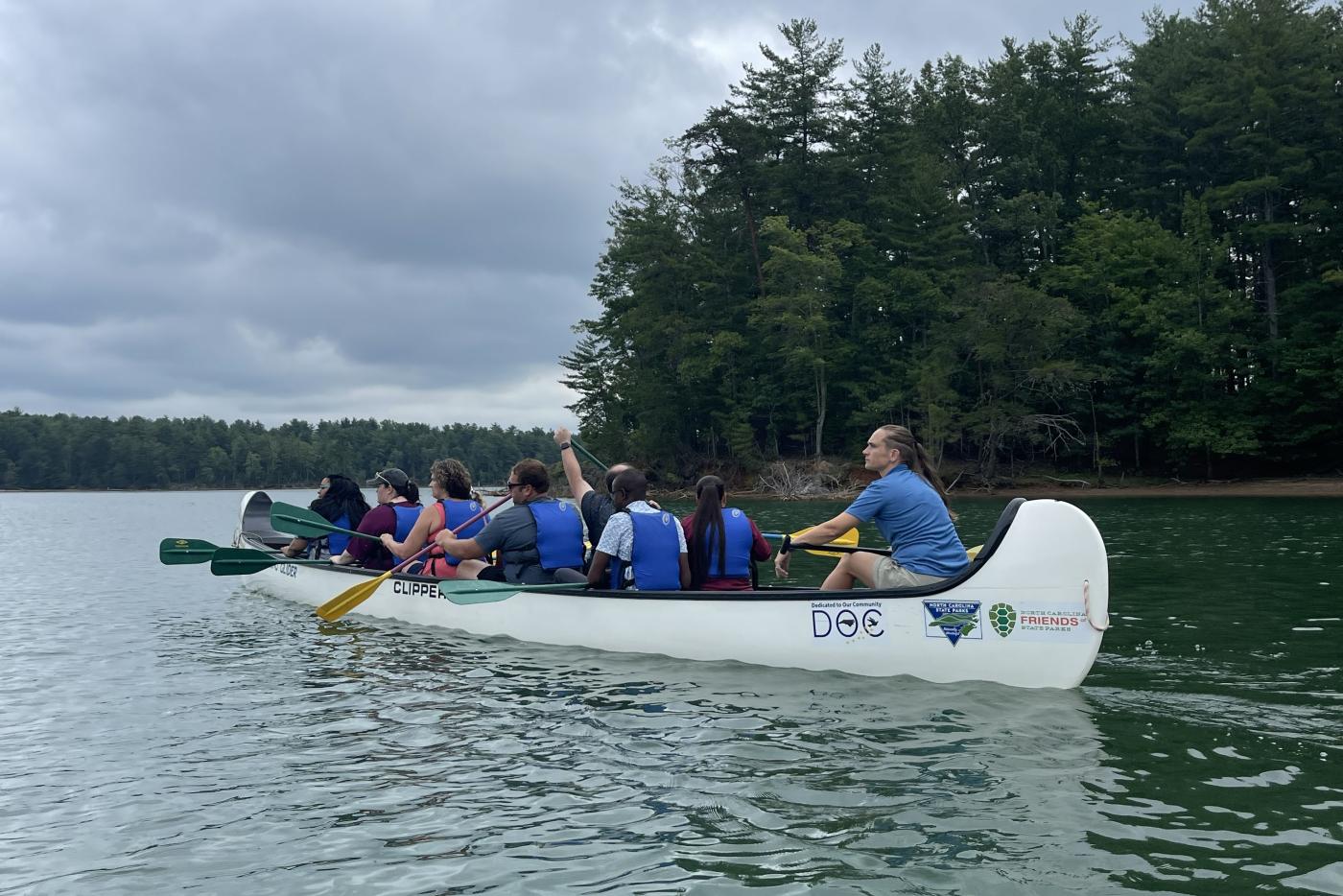
Lake James State Park has long been one of my favorite places to visit with my family. There is something captivating about a beautiful lake surrounded by the mountains of western North Carolina. Although I visit several times a year, I had never really considered its possibilities as an outdoor classroom until I returned as part of the North Carolina Department of Natural and Cultural Resources (DNCR) Teacher Ambassador program.
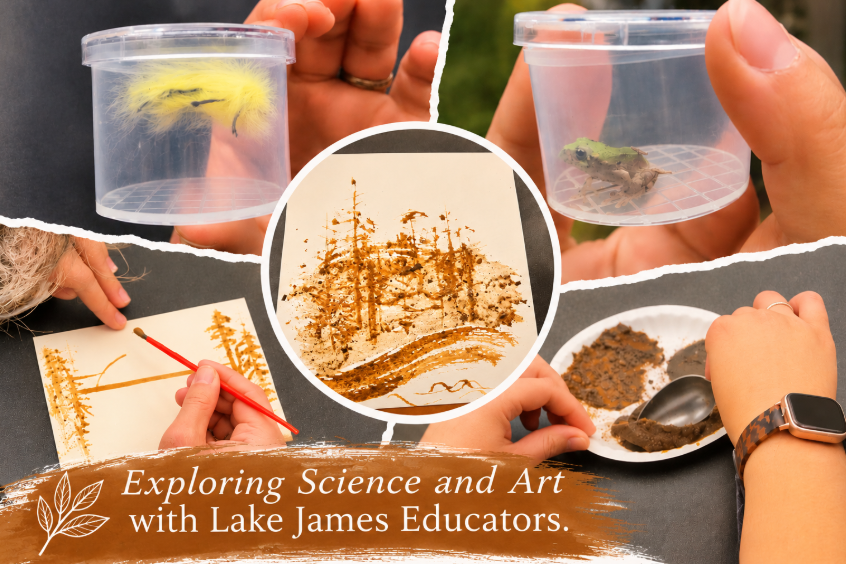
I've always loved the scenery at Lake James, but during our Ambassador visit, I found myself just as impressed with the people who work there. In just a few hours, the Schools in Parks education staff helped us explore different soil types, learn about local plants, and experience the lake itself. They even turned our exploration into a "painting with dirt" activity before connecting the day's discoveries to literature through haiku writing and thinking maps. Their ability to weave science, art, and language arts into one experience was remarkable. As a high school mathematics teacher, I couldn't help wondering what they might do with math.
From a Simple Question to an Unexpected Partnership
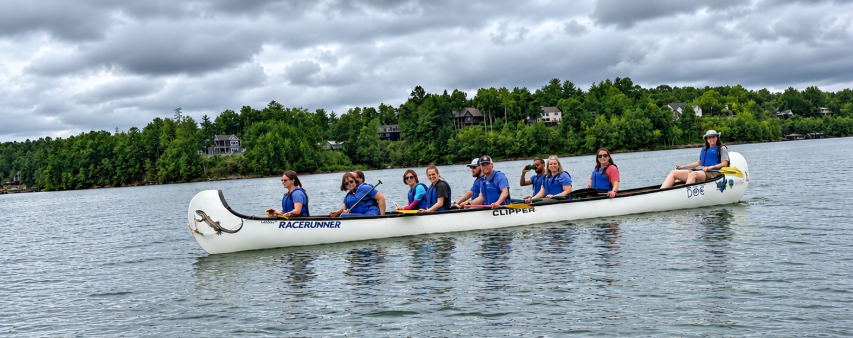
I approached the staff with what I thought was a simple request: Could they take my students onto the lake in their big canoes while I taught a trigonometry lesson using the surrounding mountains and shoreline?
I had only asked for help getting my students onto the water. Instead, the staff practically insisted on planning and teaching the lesson themselves! They encouraged me to come along, enjoy the day with my students, and leave the instructional planning to them. I don't think they could have been more excited about the idea. After experiencing their creativity and instructional expertise firsthand, I had no doubt they could develop a meaningful mathematics lesson.
We are now planning a spring trip for a group of tenth-grade Math 2 students. Many of these students have struggled with mathematics, and I am always looking for ways to help them connect what we learn in class to the world around them. At Lake James, they will have the opportunity to explore trigonometry through actual measurements, potentially calculating the height of nearby Short Off Mountain or distances across the water. The park educators are developing the experience with our mathematics standards in mind, and I am excited to see what they create.
Beyond Mathematics: Opening Doors to New Experiences
What makes this trip especially important to me, though, goes well beyond mathematics.
Several of my students have shared that they have never visited a lake. Others have only experienced a lake from the bank while fishing. Many have had limited opportunities to explore places outside their immediate communities. I want them to see the mountains, experience the lake from a canoe, and discover more of our state. I also want them to understand that mathematics can help answer real questions about the world, not just problems printed on a worksheet.
Most importantly, I want them to know that North Carolina's beautiful natural spaces are not just places for other people to enjoy. These places belong to them, too.
Beyond the Classroom: Discover What DNCR Can Offer Your Students
Being an DNCR Teacher Ambassador has helped me recognize just how much our state parks and cultural sites have to offer schools. I knew these were wonderful places to visit with family, but I hadn't fully appreciated the educational professionals working at these sites. They have the expertise to help teachers connect their curriculum to experiences students simply cannot have inside a classroom.
I hope other teachers will consider reaching out to NCDNCR sites with their own ideas, even if those ideas don't seem to fit traditional park or museum programming. You may not need to design the entire experience yourself. Sometimes it really is as simple as asking the staff what might be possible. The educators at Lake James certainly showed me that! Teachers interested in exploring similar opportunities can learn more through the park's education programs and field trip resources.
Of course, I hope my students learn some trigonometry while we're there. But if they leave wanting to bring their families back to Lake James, I will consider the day a success. Maybe they'll discover that visiting a state park is something their family can enjoy together without spending much money. Maybe they'll begin exploring other places across North Carolina. And perhaps someday they'll share those same experiences with their own children.
None of this would be possible without the educators at Lake James State Park who were willing, and genuinely excited, to take an idea from a math teacher and make it happen.
About the Author
Melia Stover is a mathematics teacher at Fred T. Foard High School in Catawba County, North Carolina, with more than 20 years of experience in education. Her career has included teaching and leadership roles across elementary, middle, and high school settings, with experience in special education, English language learning, and teacher mentorship. She is passionate about making mathematics meaningful through real-world applications, hands-on investigations, and experiences that build students' confidence and curiosity. As a 2026 DNCR Teacher Ambassador, Melia is committed to connecting classroom instruction with North Carolina's natural and cultural resources and helping fellow educators discover opportunities for learning beyond the classroom.