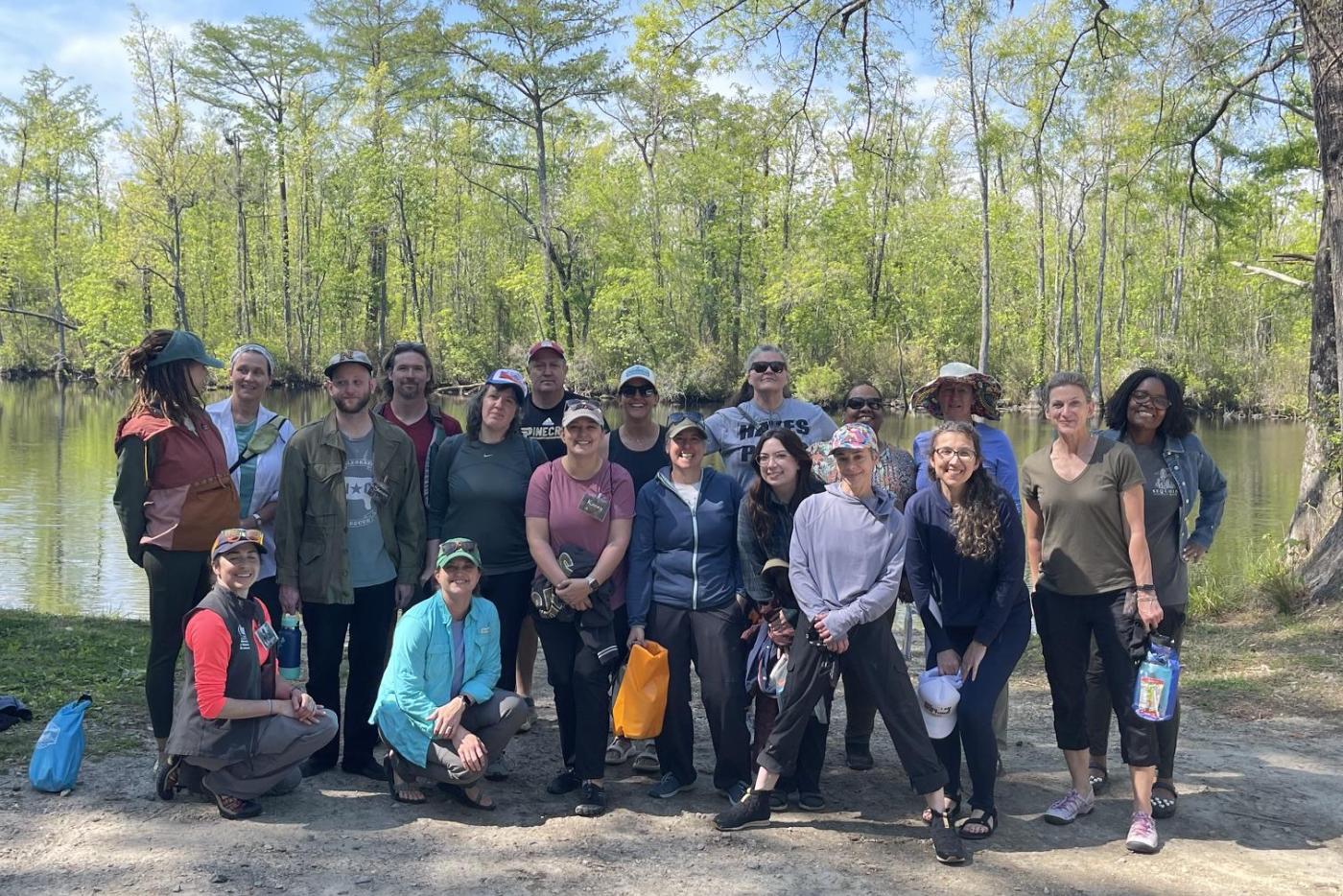
In this piece, teacher Darlene Morris reflects on her time as a participant in Rivers and Resistance: Freedom Seeking in Eastern NC | NC DNCR, an immersive, place-based workshop that explored acts of resistance, resilience, and survival of enslaved people across eastern NC. Hosted by the NC Department of Natural & Cultural Resources’ Office of K-12 Education & Outreach, NC Museum of Natural Sciences, Somerset Place, and Historic Edenton - in collaboration with Carolina K-12 at UNC-CH - the program highlighted the deep connections between the region’s ecology and the courageous strategies freedom seekers employed. The agenda included site tours, a paddle along the Cashie River, a foodways presentation by chef Ade Carrena, a performance of spirituals by Mary D. Williams, discussion, and pedagogical exploration.
Somewhere during a 3 zillion mile drive home from the Rivers and Resistance workshop, it hit me: I can’t keep teaching parts of my Biology curriculum the way I always have. Something in me shifted. Some lessons need to be immersive, I realized, with real roots.
The weekend experience of Rivers and Resistance started with a four‑hour drive from my spring break vacation to what I assumed would be a beneficial but fairly standard professional development experience. I expected something interesting, something fun, something I could fold neatly into my classroom practice. Little did I know I was in for so much more.
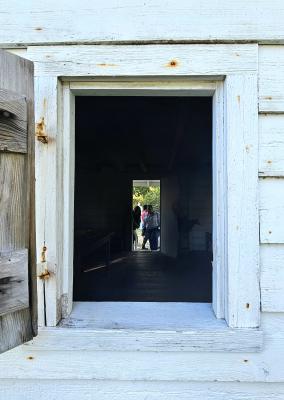
Our Friday began with a tour of Somerset Place, part of DNCR’s division of State Historic Sites, and a moment of reflection—why we were there, what we hoped to gain. My first thought was, “Whoa. Wait. Where’s the PowerPoint?”
As we toured, people talked together, drifted off to take photos, or contemplated the weight of the history we were walking through. Nothing was packaged. Nothing was rushed. It just…was.
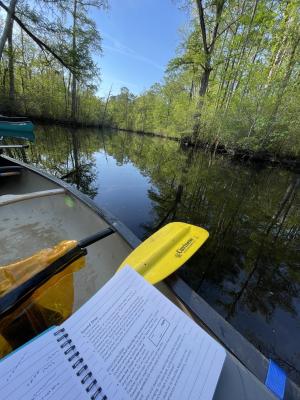
The next day pushed the limits of what I had mentally categorized as “spring break vacation.” A 5:30 a.m. wake‑up? Yes. (To be fair, they did warn me.) We started early, canoeing the small creeks off the Cashie River. This was the moment things shifted. We learned about the waterways, how they supported life, and how they tie into the histories of Indigenous communities in eastern North Carolina. It wasn’t a lesson; it was stepping inside something living. We listened to birds and fish, and a water moccasin slid lazily across the water.
I kept thinking: This is what learning is supposed to feel like.
That afternoon (no, we were not done yet), we had lunch prepared by award-winning chef Ade Carrera. No big ceremony. No formal setup. Just someone who quietly showed up and fed us. Ade and Ade’s story sparked conversation that was rich, relevant, and deeply human. (Side note: I thought I knew how to cook collard greens. I did not. Apparently, you don’t have to boil them into oblivion. I am still—quite literally—thinking about those greens.)
If you assume the day ended there, it didn’t. In the evening, we toured beautiful Historic Edenton—the first house built there, the cemetery, the mill. As a North Carolina native, I was schooled on how much history I don’t know. The Edenton Tea Party was my one small victory.
That night, Mary Williams, a scholar who specializes in spirituals, sang over dinner. Her voice filled the space—brick walls, wooden floors, all of it—and transformed it. She talked about how the energy of a space shifts depending on who’s in it and what’s being shared. I believed her. I still do.
The next morning, our tired but inspired group tackled the question that matters most: How do we take something this layered, this human, this real, and translate it into something students can feel? We talked through content, perspective, approach. Again, no formula. No checklist. We just did what educators do.
And now we’re back to my long, long drive home. Three zillion miles. I stand by that number. I spent most of it listening to The Eagles, suspended somewhere between exhaustion and deep thought.
Who will provide the grand design?
What is yours and what is mine?
’Cause there is no more new frontier—
We have got to make it here.
We’ve lived here long enough that we can’t pretend these stories are separate. Long enough that we shouldn’t keep teaching them that way. I didn’t leave with a stack of lesson plans. I left with questions. Maybe that’s the point.
But I can say this with absolute certainty: take a canoe down the Cashie. It won’t give you answers, but it might make the questions a lot harder to ignore.
Darleen Morris is a Biology and English teacher for Union County Public Schools. She loves all things nature. In addition to science, she has a strong interest in language, literature, and how ideas shape culture. Outside the classroom, she spends her time reading dystopian fiction, writing, and tending to an ever-growing collection of plants.