
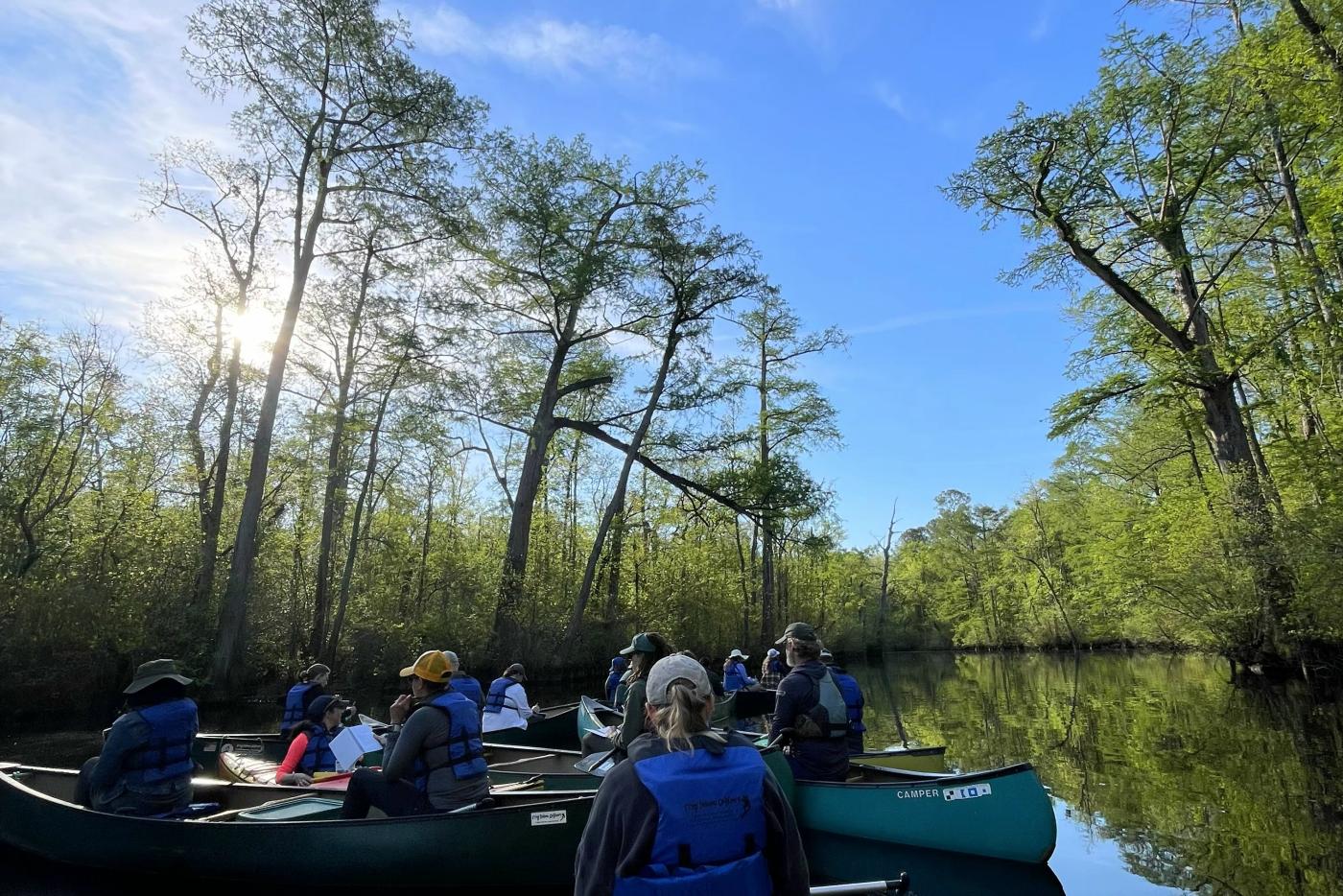
In this piece, teacher Sarah Sisler-Flohr creatively reflects on her time as a participant in Rivers and Resistance: Freedom Seeking in Eastern NC | NC DNCR, an immersive, place-based workshop that explored acts of resistance, resilience, and survival of enslaved people. Hosted by the NC Department of Natural & Cultural Resources’ Office of K-12 Education & Outreach, NC Museum of Natural Sciences, Somerset Place, and Historic Edenton - in collaboration with Carolina K-12 at UNC-CH - the program highlighted the deep connections between the region’s ecology and the courageous strategies freedom seekers employed. The agenda included site tours, a paddle along the Cashie River, a foodways presentation by chef Ade Carrena, a performance of spirituals by Mary D. Williams, discussion, and pedagogical exploration.
Candles at Somerset Place
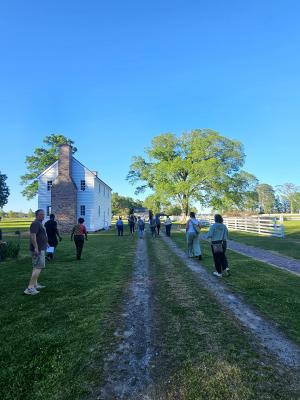
Each candle has a name. Each name, a candle: Guinea Jack, Jack Sawyer Junior, Susan, Old Sucky, Rose, Quaminy, Fanny, Smart, Becky Drew, Lewis, Joe Welcome—names for the candles on the tables representing those once enslaved on this land.
Teachers, like me, gather at those tables, at golden hour, in a place where yolk-colored light streams through bald cypress and sycamore. This place of black dirt, rich with hard history. Not hopeless, we hope. Not hopeless history—but hard as iron. There is ancient anguish here, and longing, lingering still.
When we gather at Somerset, we speak the candles’ names. We speak for those whose vivid light once shone here in a toiling, dark time. We speak the names of women who spoke to sycamores as saplings, men who turned raw soil into gleaming stalks of rice, mothers and fathers who labored without rest and without freedom to speak their own family names into so many dusks.
We speak the names of children we would have taught, if we could have—the ones we imagine guiding toward a future that was denied to them. We, the protectors of children, the tellers of hard truths—would we have defended them? Freed them from this “wide, cry-choked hell?”*
There is a quiet, separate mourning when we extinguish the candles.
And then we center ourselves in the question that follows us home:
What do we do now? How do we embody resistance and resilience—and move forward?
The Cashie River
We smell the swamp before we see it. It reeks like the rice fields at first: black water, mud on the bottom, plant and animal turning to sludge in the deep. The scent of the dying giving way to the living. When we walk, our feet sink. Our wet clothes won’t dry in the heat, and everything pulls us down. We lean into the rope and slog. The Georgia men lead us along the edge of the swamp. Water stretches in every direction, duckweed bright and green floating on the murky surface. Cypress trees, fresh with rain, shimmer.
They got islands in them swamps… You got to find them.
- From Let Us Descend, by Jesmyn Ward
We teachers, who talk so much, grow quiet here. Our boats loosely tied together, we put down our paddles and pick up our pens. We listen to the music of the river.
We make marks on paper. We make maps. We become cartographers of sound in this space above black water.
I wonder what we cannot hear—what moves below, in the cool, slow dark. When a fish leaps, the splash is a small thrill, like hope.
We are meant to write a reflection. And reflection—scientific, literal—shimmers all around us. The river, glossy as obsidian, mirrors the indigo sky, the cypress arching above and below. We are only visitors here, slipping through a breathing forest.
A kingfisher glides through the air.
A heron ascends and disappears into the canopy.
My paper gets wet. My notes bleed—blue and black, like the branches overhead.
Jesmyn Ward writes, in Let Us Descend : It is hard to imagine anyone beyond this dense wall of trees and vines, past animals seeking sun and food, across this water. Hard to imagine islands—dry places—in a world so submerged.
Yet we are here to reflect—not only on what we see, but on what we carry back.
Sustenance
What sustains you when you are moving toward freedom? – Chef Adé Carrena
What I taste more than anything is salt. Not salty—no, not that. Just salt. Salt with dimension. Salt with complexity. With story.
Have I tasted this before?
A plate of food rich with color, texture, and memory. Familiar, yet deeper. Southern, yes—but transformed.
Okra, sturdy and heat-loving, enveloped in warm spice and the earthy brightness of stewed tomato. Local legumes and rice—staples of survival—grown close to home. Fish, prepared simply and honestly. Greens, bitter and wilted, melting into cellular nourishment.
And the salt. It almost crunches. It is not a background note—it is an ingredient, a presence.
It tastes like medicine. Like spiritual medicine.
Is it the sea? The memory of water? The inheritance of ancestors?
I don’t need to know. I need to eat. To taste. To feel gratitude rise and settle in my body.
Gratitude is what sustains me as I move toward freedom. Gratitude for land, for labor, for the ecosystem of care and resilience that resists monoculture and continues to nourish all who gather at the table.
Food connects everything.
Salt of the earth.
Story made tangible.
Songs
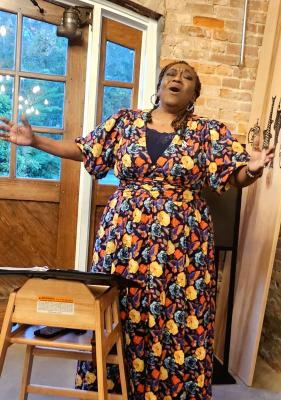
Mary D. Williams sings.
The songs hold what language alone cannot carry.
Spiritual stamina.
Sharing.
Songs of sorrow saturate.
Stories, sung, saturate—then shift.
Singing becomes revival.
Didn’t My Lord?
Lord, why come me here?
I wish I never was born.
They took away my children, Lord.
I couldn’t hear nobody praying.
I was way down yonder by myself.
Sometimes I feel like a lost child,
a long way from home.
Soon we’ll be done with the troubles of this world.
I’m going home to live.
Canaan land.
If you don’t go,
I’m going anyhow.
Ain’t nobody gonna turn me round.
Sometimes, you just have to moan.
Lesson Planning
Back in the classroom, teachers take up their packets and pens with purpose. The R words live in our hearts: Rivers, Resistance, Resilience, Reparation.
This is our shared responsibility—and where we shine.
We translate remembering, reclaiming, witnessing into learning tasks and rubrics, essential questions and success criteria. We align standards, refine objectives, and map the steps our students will take toward new realizations—ones that lead them deeper into themselves and further into the world as leaders.
We do not leave with answers.
We leave with obligations.
Rivers and Resistance reminds me to hold onto my original instincts in the environment of standards-driven education. I am not simply employed to deliver content, but to hold space for truth, complexity, and humanity.
There is only one way we continue this work: hope.
Hope, like a fish breaking the surface—brief, bright, undeniable. Hope that lives even in hard history. Hope that sustains resistance.
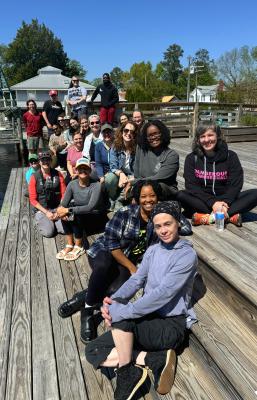
We stand around an altar of pinecones, our lesson plans tucked carefully into our bags, carrying us forward. We have cultivated hope again, nourished it through shared laughter and tears.
Hope lives among us.
We drink it like rain—rain that becomes rivers, that becomes oceans of salt and song.
We drink, and we return to our classrooms—
ready to teach, to witness, and to continue the work.
Author Bio: Sarah Sisler-Flohr is a North Carolina educator and writer whose work centers on history, place, and reflective practice. She writes about teaching, memory, and the ways educators carry learning experiences back into their classrooms and communities.